








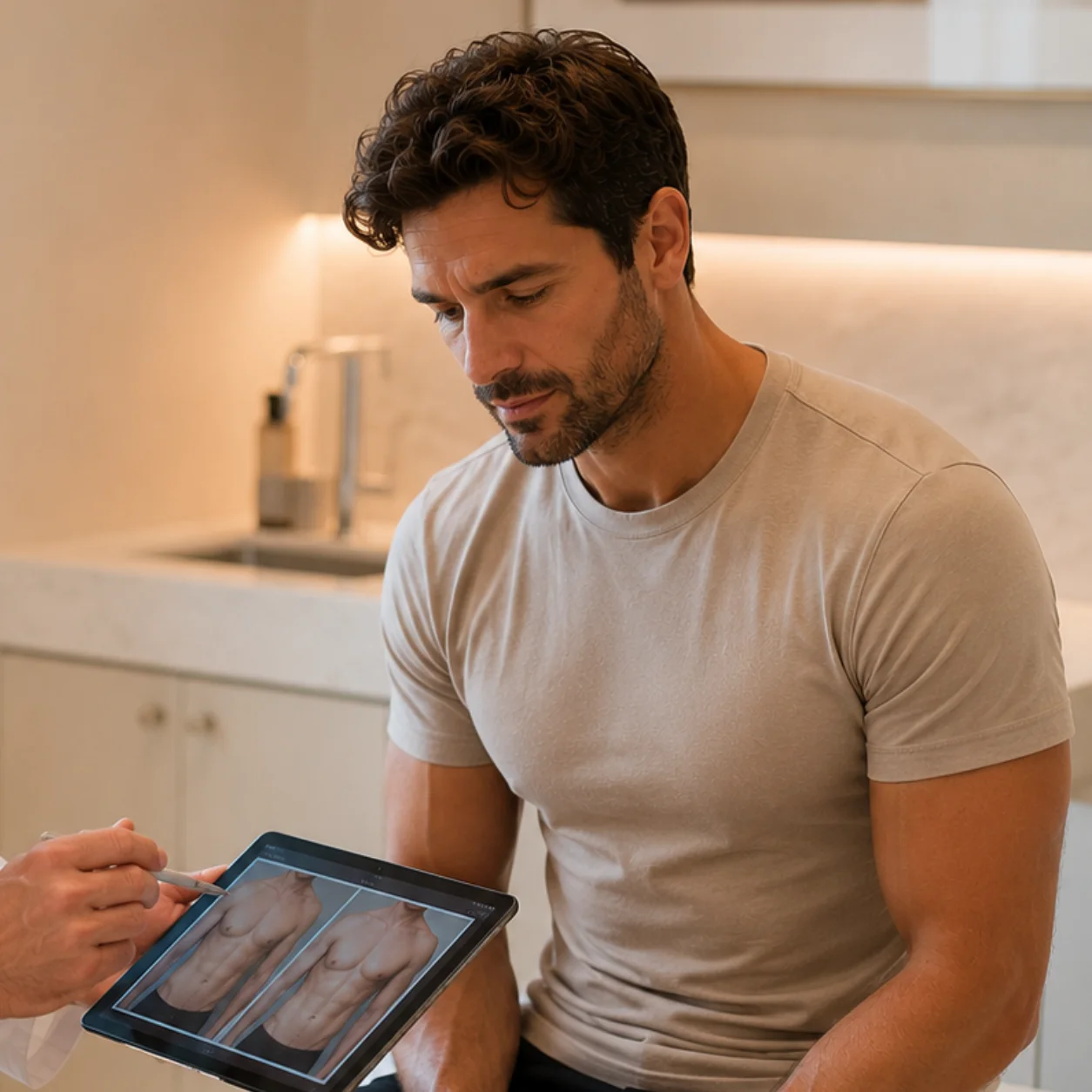









True gynecomastia is caused by glandular breast tissue, not fat. That distinction matters because glandular tissue does not respond to diet, exercise, or weight loss — it can only be removed surgically. Many men spend years assuming the problem is body fat and that leaning out will fix it. For some, that is true; for many others, the glandular component remains stubbornly present regardless of body composition. A thorough evaluation distinguishes true gynecomastia from pseudogynecomastia (fatty tissue without gland) and mixed cases, which are the most common presentation.
Gynecomastia can result from pubertal hormonal changes that never fully resolved, natural hormonal fluctuation with age, certain medications, or hormonal changes associated with performance-enhancing compounds. Regardless of the cause, the surgical approach involves direct excision of the glandular tissue through a small periareolar incision, combined with liposuction of the surrounding chest and flanks when appropriate to create a smooth, masculine, sculpted result.
Good candidates are healthy adult men who have had stable gynecomastia for at least six to twelve months, have ruled out underlying hormonal or medication causes, are at or near their stable body weight, and are bothered by the appearance of their chest. Men who are very lean and athletic are often excellent surgical candidates, though lean anatomy requires additional precision in technique and incision planning to avoid visible contour irregularities. Men who have previously had gynecomastia surgery elsewhere with unsatisfactory results — including crater deformity, residual glandular tissue, or asymmetry — are also candidates for revision surgery.
Patients in Bend, Redmond, Sisters, Sunriver, Prineville, and across the Pacific Northwest come to Alpenaura Plastic Surgery when they are ready to stop working around a problem that exercise cannot solve. For athletes and physically active men, gynecomastia is particularly frustrating because the gap between how the body looks in the gym and how it looks without a shirt can feel impossible to close. Dr. Carboy brings a direct, non-judgmental approach to every consultation and understands the specific aesthetic goals and recovery demands of active male patients.
Gynecomastia surgery is performed under general anesthesia or deep sedation as an outpatient procedure. Surgery typically takes one to two hours depending on complexity and whether liposuction is included. Incisions are placed at the periareolar border, where they heal as a nearly invisible line. A light compression vest is worn for several weeks after surgery. Most patients are comfortable returning to desk work within five to seven days, resume lower-body training within a week, and return to full chest training at four to six weeks. Final chest contour continues to refine over three to six months.
A thorough evaluation distinguishes true gynecomastia from pseudogynecomastia (fatty tissue without gland) and mixed cases, which are the most common presentation.
The surgical approach involves direct excision of the glandular tissue through a small periareolar incision, combined with liposuction of the surrounding chest and flanks when appropriate to create a smooth, masculine, sculpted result.
A light compression vest is worn for several weeks after surgery. Most patients are comfortable returning to desk work within five to seven days, resume lower-body training within a week, and return to full chest training at four to six weeks.
Final chest contour continues to refine over three to six months.
The average procedure time varies based on your personalized treatment plan and the complexity of the procedure performed
Most patients are able to return to light daily activities within a short recovery period while healing continues gradually over time
Your follow-up appointments are designed to monitor healing, support, recovery, and ensure your results continue progressing naturally.
The location of your procedure is determined vary based on your personalized needs and the complexity of the procedure performed
We understand that choosing a procedure is a deeply personal decision. Here are answers to some of the most common questions about treatment, recovery, results, and the overall Alpenaura experience.
The best way to know is a physical examination. True gynecomastia involves firm, rubbery glandular tissue that can be felt behind the nipple-areola complex. Pseudogynecomastia is softer, more diffuse fatty tissue. Many men have a mixed presentation. During your consultation at Alpenaura, Dr. Carboy will evaluate your chest to determine the tissue composition and recommend the most appropriate approach.
If the issue is primarily fat, weight loss may reduce the size of the chest. If true glandular tissue is present, weight loss will not eliminate it. Glandular tissue must be surgically removed. For men who are already lean and still have chest fullness around the nipple, surgery is almost always the only effective solution.
Incisions are typically placed along the lower edge of the areola (periareolar incision), where they heal as a fine line along the natural color transition. When liposuction is performed at the same time, small access ports are placed in inconspicuous locations on the chest or flanks. Both types of incisions become very difficult to detect once fully healed.
Most patients return to lower-body training within one week of surgery. Upper-body pushing movements, including chest pressing and push-ups, are typically restricted for four to six weeks. Dr. Carboy provides a written return-to-training protocol at the time of surgery.
If glandular tissue is fully excised, it does not regrow. However, hormonal changes — from medications, age, or resumed use of performance-enhancing compounds — can stimulate remaining tissue or cause new tissue to develop. Maintaining a stable hormonal environment is the best way to preserve long-term results.
Yes. Revision gynecomastia is one of the most common procedures Dr. Carboy performs on male patients. Common concerns include crater deformity (over-resection that leaves a divot under the nipple), residual glandular tissue, asymmetry between sides, and contour irregularities from prior liposuction. Most cases can be meaningfully improved with revision surgery.
Otoplasty reshapes and repositions the ears for a more balanced and natural appearance.
Thoughtful facial reconstruction after skin cancer removal with an emphasis on form, function, and natural-looking healing.
Facial feminization surgery tailored to soften facial features and support natural, affirming results.
Experience personalized plastic surgery and aesthetic care designed to enhance confidence with natural, refined results.