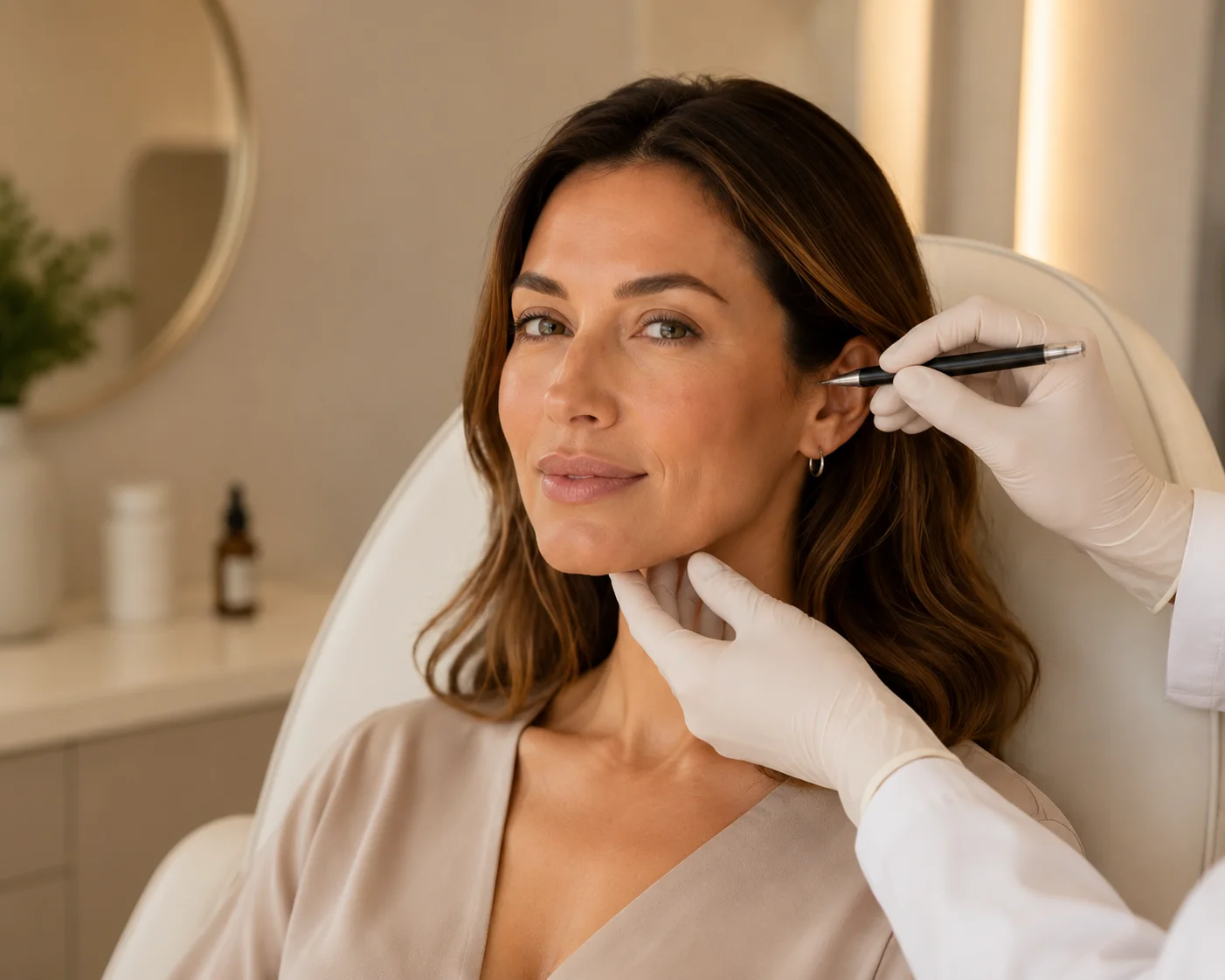












Skin cancer is unfortunately very common in Bend and across the Pacific Northwest because of the combination of high altitude, abundant sun, and an active outdoor population. While Mohs surgery is exceptionally effective at removing skin cancer with the highest cure rates and the smallest possible defect, it often leaves a wound on a highly visible part of the face, including the nose, ears, lips, eyelids, and cheeks.
Reconstructing these defects requires specialized expertise in facial anatomy, tissue handling, and aesthetic design. Depending on the location and size of the defect, reconstruction may involve careful primary closure, skin grafting, local tissue rearrangement, or more advanced flap techniques that recruit nearby skin to recreate the natural contour and texture of the area.
Almost any patient who has had a Mohs procedure that leaves a visible facial wound is a candidate for formal reconstruction. Some small wounds in low-visibility areas heal well on their own, but most facial defects benefit from reconstruction by a plastic surgeon who specializes in restoring both form and function. Dr. Carboy frequently performs reconstructions on the nose, lips, eyelids, ears, cheeks, forehead, and scalp.
Central Oregon has one of the highest skin cancer rates in the Pacific Northwest because of its sunny climate and outdoor lifestyle. Patients in Bend, Redmond, Sisters, Sunriver, Prineville, La Pine, and surrounding communities want to know that the surgeon putting their face back together has both the technical training and the aesthetic eye to deliver the best possible result. Dr. Carboy’s background in plastic surgery allows her to plan reconstructions that respect facial subunits, hide scars within natural skin lines, and preserve the function of structures like the eyelids, nose, and lips.
Most Mohs reconstructions are performed in the office under local anesthesia or with light sedation, on the same day as the Mohs procedure or shortly afterward. Larger or more complex reconstructions may be performed in the operating room. Recovery varies depending on the location and complexity of the reconstruction, but most patients return to desk work within three to seven days, with sutures removed at five to ten days. Final scar appearance continues to refine for up to a year, and Dr. Carboy follows patients carefully throughout this process to optimize the result with massage, sun protection, and, when needed, in-office scar treatments.
Dr. Carboy coordinates closely with local Mohs surgeons to schedule reconstruction as efficiently as possible.
Most Mohs reconstructions are performed in the office under local anesthesia or with light sedation, on the same day as the Mohs procedure or shortly afterward.
Most patients return to desk work within three to seven days, with sutures removed at five to ten days.
Final scar appearance continues to refine for up to a year.
The average procedure time varies based on your personalized treatment plan and the complexity of the procedure performed
Most patients are able to return to light daily activities within a short recovery period while healing continues gradually over time
Your follow-up appointments are designed to monitor healing, support, recovery, and ensure your results continue progressing naturally.
The location of your procedure is determined vary based on your personalized needs and the complexity of the procedure performed
We understand that choosing a procedure is a deeply personal decision. Here are answers to some of the most common questions about treatment, recovery, results, and the overall Alpenaura experience.
In most cases, reconstruction is performed the same day or within a day or two of the Mohs procedure, while the wound is still fresh. Dr. Carboy coordinates closely with local Mohs surgeons to schedule reconstruction as efficiently as possible.
Most patients feel comfortable returning to work and social activities within ten to fourteen days, once the splint is removed and the bulk of bruising has resolved. Strenuous exercise is usually restricted for three to four weeks. Subtle swelling, particularly in the tip, can take up to a year or longer to fully resolve.
Refined rhinoplasty designed to enhance facial harmony, improve balance, and support natural-looking results.
Otoplasty reshapes and repositions the ears for a more balanced and natural appearance.
Facial feminization surgery tailored to soften facial features and support natural, affirming results.
Experience personalized plastic surgery and aesthetic care designed to enhance confidence with natural, refined results.